GRAFIKDATEN – ANALOG GERENDERT
GRAPHIC DATA – RENDERED ANALOG
FLATSHADE
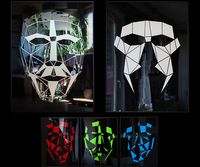
Schattierungslose Geometrie symbolisiert digitale Reduktion des Organischen und Realen. Verzerrte Spiegelungen erzeugen optische Räumlichkeit oder ziehen den Blick über einen Ereignishorizont auf die virtuelle Seite des Bildschirms.
Shadeless geometry symbolizes digital reduction of the organic and the real. Distortively reflectiions create an optical sense of spatiality, or draw the gaze across an event horizon toward the virtual side of the screen.
RAYTRACE
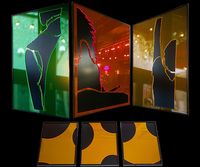
Reflektion levitiert Schattenrisse als fluoreszierende Vektorgrafiken zwischen dem realen und virtuellen Raum. Transparenz vor seidenmattem Schwarz erzeugt lichtabhängige Farbnuancen.
Reflection levitates shadow silhouettes as fluorescent vector graphics between real and virtual space. Transparency against silk-matte black generates light-dependent chromatic nuances.
ANGEKÜNDIGT

TEXMAP

PANEL ART analogisiert den Bildschirm und simuliert Computergrafik auf schwarzen Wandtafeln: Digitales Selbstleuchten, Darstellungsmodi, separierte Attribute wie Glanz, Reflexion oder Schatten, sowie nahtlos kachelbare Texturen. Im postdigitalen Kontext werden virtuelle Originale in Abbildern manifestiert.
Industrielle Plattenware aus Acrylglas und Aluverbund, sowie Meterware wie Tolex entsprechen als Werkstoff konzeptuell der binären Perfektion und Reproduzierbarkeit. Gegenstände jedoch sind fehlerhaft: Nachlässige Qualitätskontrolle bei Herstellung, Bearbeitung und Transport beschädigen das Material. Doch im Prozess der Realwerdung meiner Wandobjekte entstehen damit Signaturen der Einzigartigkeit, und stützen so meine Beschränkung auf Unikate und Kleinsteditionen.
Das Massenmaterial setzt auch der Gestaltbarkeit Grenzen: Wenige Oberflächen, Grundfarben und Lichtdurchlässigkeit. Thermische Dehnung und Kratzempfindlichkeit, sowie automatisierte Dateninterpretation für die groben Schnittverfahren, zwingen mir als Objektemacher einen Minimalismus auf, der ohne Konzeptbewusstsein leicht als pure Dekoration gesehen werden kann.
Der Metallrahmen ist nicht nur Träger der massiven Einzelwerke und symbolisches Displaygehäuse. Er dient als inhaltlicher Verstärker bei geteilten Motiven, die Distanzen als Illusion entlarven möchten: Im Triptychon, das Zeit überbrückt. Im Bildpaar, das Perspektiven synchronisiert.
Werke mit der Zusatzbezeichnung -overscan hingegen skalieren Motive über die Bildbegrenzung hinaus, um sie zu abstrahieren oder in neuem Kontext zu betrachten. Diese experimentellen Arbeiten dehnen das Thema ihrer Serie, sind damit jedoch Vorboten der stetigen konzeptuellen Entwicklung.
Panel Art analogizes the screen and simulates computer graphics on black wall panels: digital self-illumination, rendering modes, and discrete attributes such as gloss, reflection, or shadow, as well as seamlessly tileable textures. In the post-digital context virtual originals are manifested in physical copies.
Industrial sheet materials made of acrylic glass and aluminium composite, as well as by-the-meter goods such as Tolex, correspond conceptually as materials to binary perfection and reproducibility. Objects, on the other hand, are flawed: careless quality control during manufacturing, processing and transport damages the material. Yet in the process of becoming real, these imperfections generate signatures of uniqueness in my wall objects and reinforce my restriction on unique pieces and very small editions.
At the same time, the mass-produced material imposes limits on form: few surface types, basic colors, and degrees of translucency. Thermal expansion, susceptibility to scratches, and automated data interpretation for coarse cutting processes compel me, as an object artist, toward a minimalism that, without conceptual awareness, can easily be perceived as mere decoration.
The metal frame is not only a structural support for the solid individual works and a symbolic display casing. It also functions as a conceptual amplifier in divided compositions: distances are exposed as illusion – whether in the triptych, which bridges time, or in paired images that synchronize perspectives.
Works bearing the suffix -overscan, on the other hand, scale motifs beyond the boundaries of the image in order to abstract them or reconsider them within a new context. These experimental works expand the thematic scope of their series, while simultaneously foreshadowing an ongoing conceptual evolution.